
If your product includes a display — a laptop panel, an industrial monitor, or an embedded touchscreen — you’ll likely need to choose between an LVDS cable and an eDP cable to connect it. Both transmit video data, but they’re built for different generations of display technology, and picking the wrong one can mean redesigning your board later.
What LVDS Is
LVDS (Low-Voltage Differential Signaling) has been the standard display interface for over two decades. It’s a mature, well-documented technology supported by a wide range of display panels, especially in industrial equipment, older laptop models, and automotive infotainment systems still using legacy panel designs. LVDS cables are widely available, cost-effective, and easy to source connectors for (commonly Hirose DF14, DF19, or JAE FI-X series).
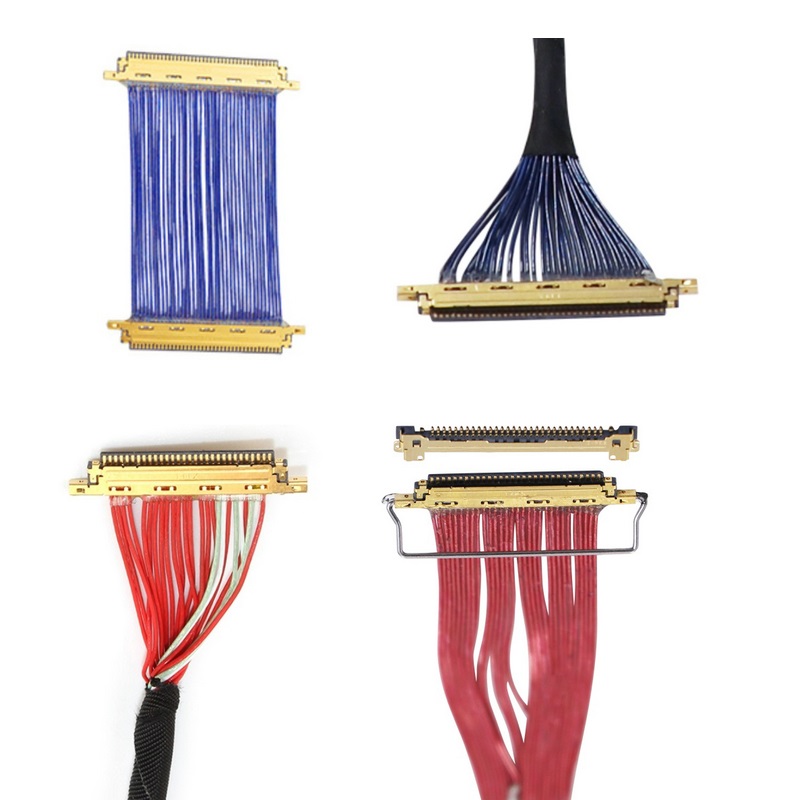
Custon I-PEX Micro-coaxial Cable
What eDP Is
eDP (Embedded DisplayPort) is the newer standard, built on the VESA DisplayPort specification. It supports higher resolutions (4K and beyond) with fewer wires and lower power consumption than LVDS. Most current-generation laptop, tablet, and high-resolution industrial displays use eDP. If your display panel supports 4K, or if power consumption is a priority (battery-powered devices, for example), eDP is usually the better fit.
Key Differences at a Glance
- Bandwidth: eDP supports significantly higher resolutions and refresh rates than LVDS.
- Power consumption: eDP typically uses less power for the same resolution, which matters for battery-powered or thermally constrained designs.
- Wire count: eDP requires fewer signal pairs than LVDS for a given resolution, which can simplify cable design.
- Panel availability: LVDS panels are still common in industrial and legacy applications; eDP panels dominate current consumer and high-resolution industrial displays.
- Cost: LVDS cable assemblies are generally slightly less expensive due to mature, high-volume manufacturing.
Which One Should You Choose?
If you’re designing a new product with a current-generation display panel, check the panel’s datasheet first — most panel manufacturers now default to eDP for anything above HD resolution. If you’re replacing or servicing an existing industrial system that already uses LVDS panels, staying with LVDS avoids compatibility issues with your existing hardware.
For mixed situations — for example, an eDP panel that needs to connect to an LVDS-only display controller — eDP-to-LVDS converter cables are also available, though they add cost and a small amount of signal latency.
If you’re not sure which interface your panel uses, send us the panel part number or datasheet and we can confirm the correct cable assembly specification before you commit to a design.