
Choosing the right AWG (American Wire Gauge) for a micro coaxial cable is one of the first decisions in any custom cable assembly project. The gauge affects diameter, flexibility, current-carrying capacity, and signal loss — and getting it wrong usually means a redesign later. Here’s a practical breakdown of the four gauges we work with most often: AWG 40, 42, 44, and 46.
AWG 40
AWG 40 is the thickest of the four, with a conductor diameter around 0.08 mm. It offers the lowest signal loss and the best durability during repeated flexing, which makes it a common choice for camera module cables, drone gimbal cables, and other applications where the cable will be bent or flexed thousands of times over its service life. The trade-off is a slightly larger overall cable diameter, which matters in space-constrained designs.
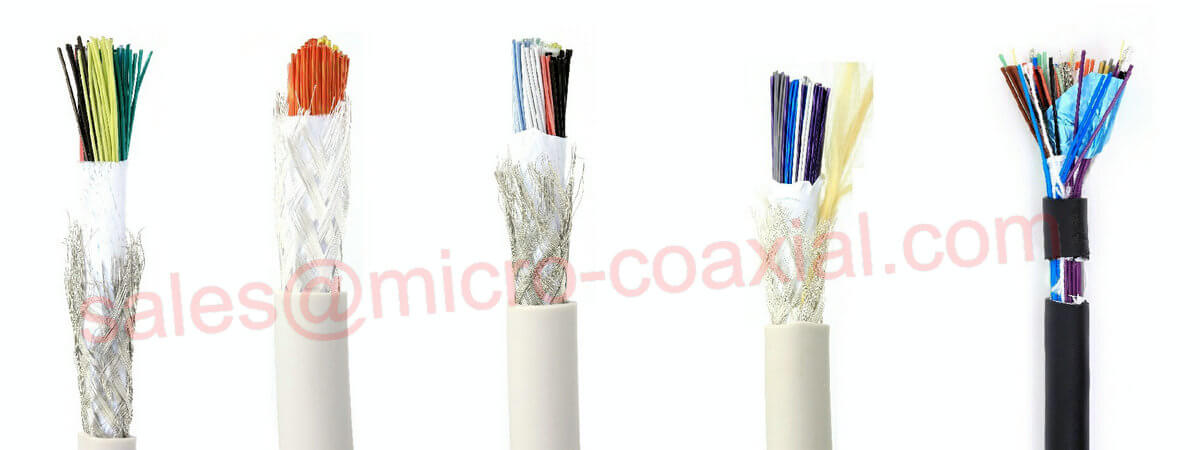
Multi-core Coaxial Cable, Hybrid Coaxial Cable, Bundled Coaxial Cable, Ultrasound Probe Cable, Ultrasound Coaxial Cable,Custom Multi-core Coaxial Cable, Custom Hybrid Coaxial Cable, Custom Bundled Coaxial Cable, Custom Ultrasound Probe Cable, Custom Ultrasound Coaxial Cable,Medical Imaging Cable, Imaging Sensor Cable
AWG 42
AWG 42 sits in the middle, with a conductor diameter around 0.064 mm. It’s a good default choice when you need a balance between flexibility and space savings — many industrial camera and medical imaging designs use AWG 42 as a starting point before testing thinner options.
AWG 44
AWG 44 (around 0.05 mm conductor diameter) is common in compact consumer electronics and wearable devices, where board space is limited but the cable doesn’t need to survive extreme flex cycles. Signal loss is higher than AWG 40 or 42, so AWG 44 works best for shorter cable runs.
AWG 46
AWG 46 is the thinnest gauge we regularly process, with a conductor diameter around 0.04 mm. It’s used in ultra-compact designs — miniature endoscopes, small sensor modules, and high-density connector arrays — where every fraction of a millimeter counts. AWG 46 requires more precise termination and testing, since the finer wire is more sensitive to handling during assembly.
How to Choose
In practice, the decision usually comes down to three questions:
- How much space do you have? If board space or connector pitch is the limiting factor, thinner gauges (44/46) may be necessary regardless of other trade-offs.
- Will the cable flex repeatedly? Applications with dynamic flexing (drones, robotics joints, foldable devices) generally favor thicker gauges (40/42) for durability.
- How long is the cable run? Longer runs amplify signal loss differences between gauges, so thinner gauges are better suited to short runs.
If you’re not sure which gauge fits your application, send us your connector part numbers and space constraints — we can recommend a gauge based on similar projects we’ve completed for medical, camera module, and robotics customers.