
Medical device applications — ultrasound probes, endoscopes, imaging sensors — place demands on micro coaxial cable that go beyond typical consumer or industrial requirements. Here’s what to consider when specifying cable for a medical application.
Flex Life and Durability
Many medical devices, particularly handheld probes and endoscopes, subject cables to repeated flexing over the product’s service life. Cable and connector selection should account for expected flex cycles, not just static electrical performance. Thicker AWG gauges (40/42) and specific jacket materials designed for flex durability are often preferred over thinner gauges in these applications, even though thinner gauges may save space.
Sterilization Compatibility
Devices that undergo sterilization — autoclave, ethylene oxide (EtO), or chemical disinfection — need cable jacket and connector materials rated for the specific sterilization method used. This should be confirmed with the cable manufacturer before finalizing material selection, since not all standard cable jackets are rated for high-temperature autoclave cycles.
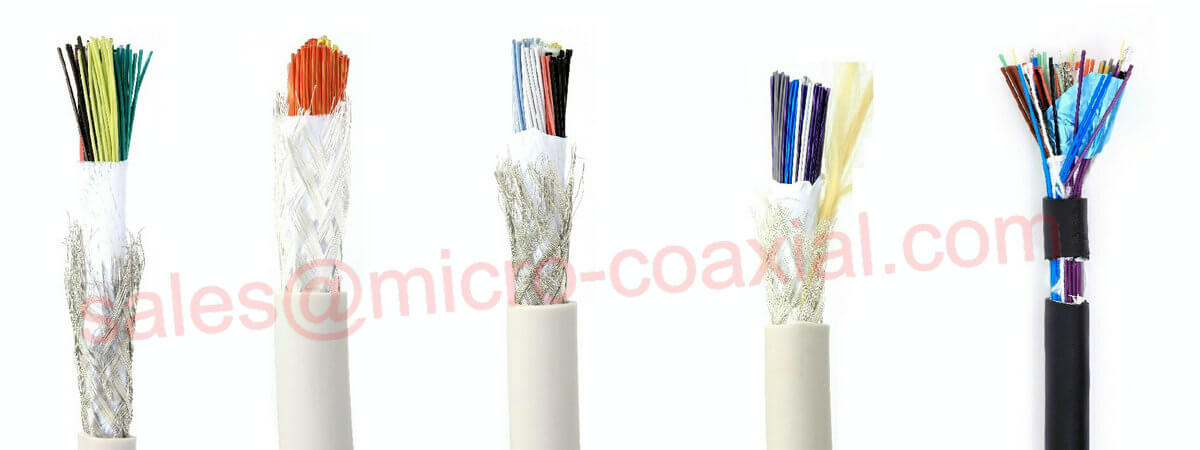
Multi-core Coaxial Cable, Hybrid Coaxial Cable, Bundled Coaxial Cable, Ultrasound Probe Cable, Ultrasound Coaxial Cable,Custom Multi-core Coaxial Cable, Custom Hybrid Coaxial Cable, Custom Bundled Coaxial Cable, Custom Ultrasound Probe Cable, Custom Ultrasound Coaxial Cable,Medical Imaging Cable, Imaging Sensor Cable
Biocompatibility
For cables that may have direct or indirect patient contact, biocompatibility testing (per ISO 10993 series) may be required depending on the device classification. This affects material selection for jackets, overmolding, and any adhesives used in the cable assembly.
Signal Integrity for Imaging Applications
Ultrasound and imaging applications are particularly sensitive to signal loss and crosstalk, since signal quality directly affects image resolution. Multi-core coaxial constructions with careful shielding and controlled impedance are common in these applications, and testing (impedance, insertion loss) is typically part of the qualification process, not just production QC.
Traceability and Documentation
Medical device manufacturers typically need full material traceability — lot numbers, material certificates, and test records — to support their own regulatory documentation (FDA 510(k), CE marking, etc.). Working with a cable assembly supplier that holds ISO 13485 certification and can provide this documentation as standard practice saves significant time compared to requesting it after the fact.
Common Connector Choices
KEL, Hirose DF56, and I-PEX CABLINE series are frequently used in medical imaging and endoscope applications due to their fine pitch and flex durability. The right choice depends on your specific space constraints and flex requirements.
Working with Your Cable Supplier Early
Because medical applications have more constraints than typical industrial cable assembly, it’s worth involving your cable supplier during the design phase rather than after the mechanical design is finalized — material and connector choices made early can avoid costly redesigns during regulatory review.
If you’re specifying cable for a medical device, send us your sterilization method, expected flex cycles, and any regulatory requirements, and we can recommend a construction that fits.